
Tiered Link Building - Advanced Tactics & Risk Management
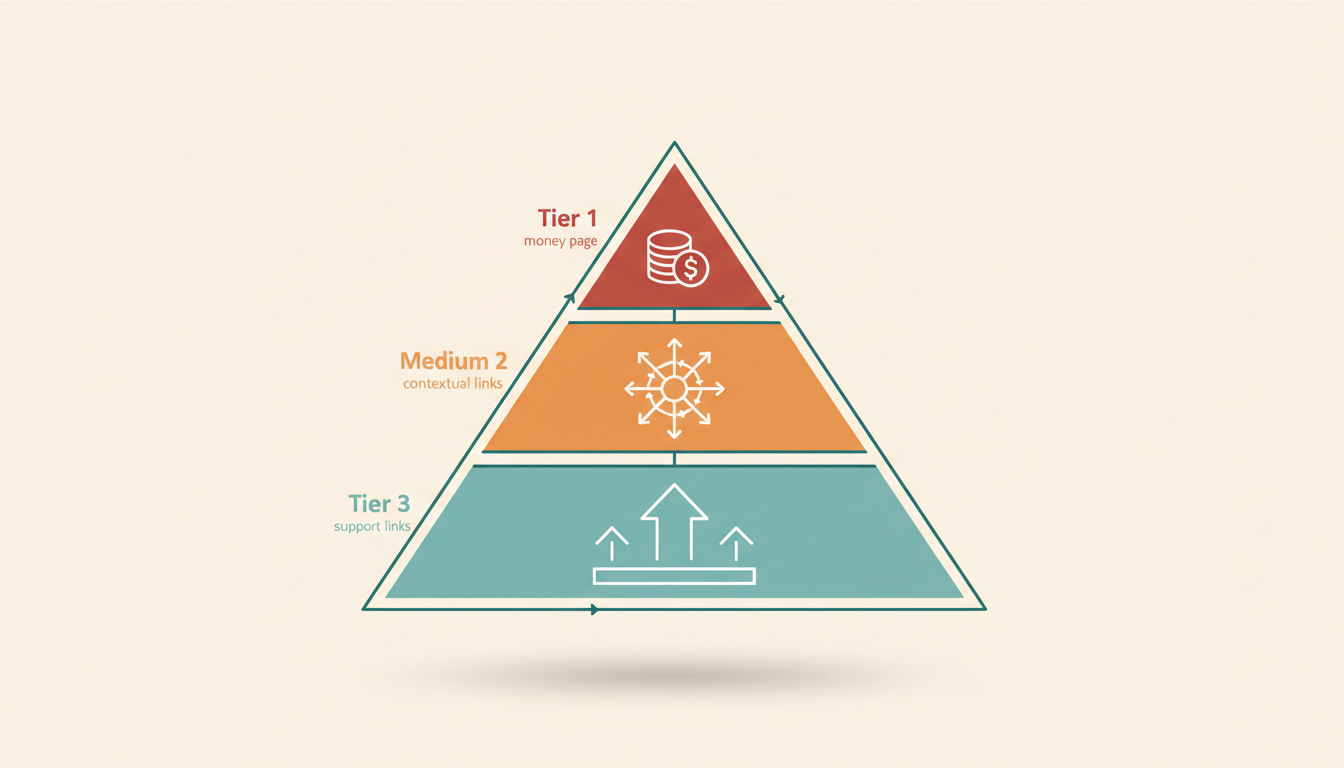
Tiered link building is one of those tactics that sounds clever in theory but gets ugly fast in practice. The idea is simple: instead of pointing all your links directly at your money page, you build a pyramid where lower-tier links support your Tier 1 backlinks, pushing authority upward indirectly. In my experience, it works best as a surgical amplifier for a handful of strong assets — not as a scalable strategy.
I've tested this approach on a few competitive campaigns, and I can tell you: the moment you start scaling with cheap web 2.0 properties or automated content, you're building a footprint that Google can spot from a mile away. This page breaks down the mechanics, the quality thresholds that actually matter, and how to decide if tiered link building is worth the risk for your site.
At a glance
- Best for
- Advanced campaigns with established Tier 1 assets
- Risk level
- High when scaled, moderate when surgical
- Time to impact
- 4-12 weeks (depends on indexing speed)
- Common failure mode
- Tier 2/3 links devalued without passing equity
Core Mechanics
Tiered structures work by pushing link equity upward through a pyramid: Tier 1 links point to your target page, Tier 2 links point to Tier 1 assets, and Tier 3 (if used) supports Tier 2. This differs from direct link building where all links point to the money page.
The theory is that by amplifying the authority of your Tier 1 links, you indirectly boost your target page. But here's the catch: every extra tier introduces more variables and more opportunities for something to break. If your Tier 2 links are junk, they won't pass value — and they might even create a pattern that triggers a manual review.
I've seen campaigns where people build 50 Tier 2 links to a single Tier 1 asset, only to have that asset lose rankings because the supporting links were all from the same spun-content network. The pyramid only works when each layer is genuinely useful.
Tier Quality Thresholds
Each tier must meet minimum quality standards to pass value. Based on what I've seen work and fail, here are the thresholds I use:
- Tier 1: Editorial links from relevant sites with real traffic (DR 40+). These are your foundation — don't skimp here.
- Tier 2: Contextual placements on indexed pages (DR 20+). Guest posts, niche edits, or legitimate resource mentions work well.
- Tier 3 (optional): Niche-relevant citations or profiles. This is where most people mess up by using bookmarking or comment spam.
I've found that if your Tier 1 links are weak, no amount of Tier 2 support will fix them. The pyramid amplifies existing strength — it doesn't create it from nothing.
Execution Risks
Common failure points include:
- Using deindexed or nofollowed Tier 2 links that pass no equity
- Creating obvious anchor text patterns across tiers
- Building on platforms Google actively devalues (spun content sites, PBNs)
- Over-relying on web 2.0 backlinks for Tier 2
I once audited a campaign where the SEO had built 200 Tier 2 links from WordPress.com and Blogger — all with exact-match anchors. The Tier 1 links were solid, but the whole structure got deindexed within three months. The footprint was just too obvious.
Another risk: if your Tier 1 links disappear or get deindexed, the whole structure weakens. You're not just maintaining one set of links — you're maintaining three.
Alternative Approaches
For most sites, hybrid strategies outperform pure tiering. Here's what I usually recommend:
- 80% direct editorial links + 20% tiered support
- Using tiers only for indexation help on strong assets
- Focusing on linkable assets rather than link pyramids
Direct organic link building through PR, guest posts, and digital outreach is almost always cleaner and more defensible. Tiered building is a niche tool, not a replacement for solid link earning.
If you're considering tiered building, ask yourself: would the same effort spent on earning one more editorial link give you better results? For most sites, the answer is yes.
Anchor Text Strategy
Anchor text distribution is critical across tiers. PressWhizz suggests a Tier 2 anchor mix of 60% branded/generic, 30% partial-match, and 10% naked URLs. I've found that exact-match anchors on Tier 2 are a red flag — they create a pattern that algorithms can detect.
For Tier 3, I'd go even heavier on branded and generic anchors. The further down the pyramid you go, the more natural the anchors should look. Think about how real sites link to each other — they don't all use the same keyword phrase.
One trick I use: vary the anchor text not just by keyword, but by context. A Tier 2 link from a guest post should use a different anchor than one from a niche edit or a profile placement.
Monitoring and Maintenance
You can't just build tiers and forget them. I recommend monitoring:
- Indexed status of Tier 1 and Tier 2 links monthly
- Lost links — if a Tier 1 link disappears, the whole structure weakens
- Referral traffic and ranking movement for the target page
To check if Tier 2 links are passing value, monitor your Tier 1 URL's DR and rankings before and after deployment. No movement suggests the Tier 2 links aren't working. Tools like Ahrefs or SEMrush can help, but manual checks are still valuable.
I've had campaigns where Tier 2 links looked good in the tool but didn't move rankings at all. The links were indexed, but they weren't passing equity — probably because Google devalued them as part of a pattern.
When to Use Tiered Link Building
I only recommend tiered link building in specific scenarios:
- You have a small set of strong, editorial Tier 1 links that you want to amplify
- You're testing a competitive keyword where direct links are hard to earn
- You need to help index a valuable asset (e.g., a new infographic or research page)
For e-commerce sites, I'd use it only on a limited basis for strong category pages or linkable assets. For most sites, natural link building and digital PR are safer and more durable.
If you're tempted to use tiered building as a cheap volume play, don't. The cost of cleaning up a penalty or recovering from deindexation is far higher than the short-term gains.
Tiered vs non-tiered link building strategies
Here's how tiered link building compares to other link building strategies:
| Strategy | How it works | Best use case | Main risk | Quality ceiling |
|---|---|---|---|---|
| Tiered link buildingBuilds a pyramid: supporting links amplify other backlinks instead of pointing directly at the target page. | Supports Tier 1 links indirectly | Advanced campaigns with strong existing Tier 1 | High spam footprint if scaled badly | Capped by the quality of Tier 1 and Tier 2 assets |
| Direct non-tiered link buildingEarns or places links straight to the target page via outreach, PR, guest posts, digital PR, or niche edits. | Points authority directly to the money page | Most brands and agencies | Lower manipulation risk | Higher ceiling when links are truly editorial |
| Hybrid approachUses mostly direct links, with limited support layers for indexing or strengthening select assets. | Direct links plus selective support | For controlled, mixed-risk campaigns | Moderate complexity and cost | Better than pure tiering for most sites |
| Pure web 2.0 / buffer linksLower-quality support properties used as a substitute for real backlinks. | Mostly support pages and satellites | Cheap volume play | High deindex/spam risk | Low |
Arguments for
- Can amplify strong Tier 1 links without needing every backlink to point directly at the money page.
- Useful for testing or boosting a small set of high-value URLs.
- Lets SEOs control anchor mix and topical support across layers.
- Can help with crawl discovery or indexing of supporting assets when executed carefully.
Arguments against
- Hard to execute cleanly at scale.
- Quality drops quickly if Tier 2 and Tier 3 are junk.
- Often overlaps with spam tactics and link-scheme behavior.
- Usually less defensible than direct editorial link acquisition.
What the experts say
John Mueller has repeatedly stated that Google's algorithms are designed to ignore manipulative link patterns, including those created by tiered structures. He emphasizes that quality and relevance matter more than the number of supporting links.
What it costs (and why prices are unreliable)
No reliable public market price exists for tiered link building because it is sold as a custom service. Cost is driven by Tier 1 quality, content production, outreach labor, volume of supporting links, and whether the work uses earned placements versus automated or low-quality web 2.0 properties.
Frequently asked questions
How many Tier 2 links per Tier 1 link?
3-5 quality Tier 2 links per Tier 1 asset is a safe ratio. Avoid creating exact 1:1 match patterns that algorithms can detect.
Should Tier 2 links use branded anchors?
Yes, 60-70% of Tier 2 anchors should be branded or generic. Exact match anchors increase footprint risk when scaled.
Can I automate Tier 2 link building?
Limited automation (e.g., profile creation) is possible, but automated content creation for Tier 2 almost always creates detectable spam.
How to check if Tier 2 links are passing value?
Monitor Tier 1 URL DR/rankings before/after Tier 2 deployment. No movement suggests the Tier 2 links aren't working.
What's the safest Tier 2 link type?
Contextual niche edits on existing quality pages carry lower risk than new web 2.0 pages or blog comments.
Does tiered link building still work in SEO?
It can still work as an amplifier when the first-tier links are strong and the support layers are relevant and restrained. It is much less reliable when used as a cheap volume tactic, because spam patterns and low-quality links get devalued fast.
Sources
Every factual claim on this page is drawn from the following independent sources. Links open in a new tab.
- PressWhizz — Tier 2 anchor mix, cadence, and volume heuristics for tiered link building.
- Infinity Rank — Auditing Tier 1 links, using SEO tools, and monitoring tier performance.
- Building Backlinks — Benchmarks, review cadence, and the need to evaluate results over time.
- WhitePress — Selecting strong Tier 1 links, monitoring link status, and starting small.
- W3Era — Guest posts, niche edits, broken-link building, web 2.0, bookmarking, and indexing tactics.
- The Blueprints — Web 2.0 platforms, profiling, social signals, automation, spun content, and tier ratios.
- SEO Sandwitch — Tier definitions and the indirect flow of authority from Tier 2 to Tier 1.
- Ken Sho Media — Quality, relevance, anchor diversification, pacing, and Google link-scheme risk.